I
Origins
Founded in 1935
First boys arrived 10 September 1935; formally opened by the Viceroy, Lord Willingdon, on 27 October 1935.
Knowledge Our Light
 Founder’s 91The Doon School · 91st Founder’s Day · 22–24 October 2026
I
Founded in 1935
First boys arrived 10 September 1935; formally opened by the Viceroy, Lord Willingdon, on 27 October 1935.
Knowledge Our Light
II
III
I · Origins
S.R. Das admired how the great English public schools built character, but wanted a school that was Indian at heart: national in outlook, free of religious bias, and open to boys of every caste, creed and community. Jawaharlal Nehru supported the idea; Mahatma Gandhi and Rabindranath Tagore felt such a school would be elitist.
When Das died in 1928 only a small part of the money had been raised, and by 1934 some donors wanted it back. Sir Joseph Bhore became chairman of the Society and, with Sir Frank Noyce and Sir Akbar Hydari, secured the Chandbagh estate on favourable terms after the Forest Research Institute moved out.
A committee in England led by Lord Halifax chose Arthur Foot, a science master at Eton who had never been to India, as first Headmaster. He asked John Martyn, a Harrow housemaster, to be his deputy; Martyn came to put Kurt Hahn's ideas into practice: character built through responsibility and challenge, especially outdoors.
Seventy boys joined in the first term and another 110 in the second. Latin was never central; most boys studied Hindi or Urdu. Prayers were non-denominational from the start. The first leavers left in 1938, and about sixty-five Doscos served in the Second World War.
“An aristocracy of service inspired by the ideals of unselfishness.”
Not of privilege, wealth or position, but of service.
II · The Headmasters
1. Arthur E. Foot1935–1948
Winchester-educated Eton science master and Alpine Club member; shaped the School's routines, vocabulary and ideal of service. Kaisar-i-Hind Gold Medal (1946), CBE (1948).
2. John A.K. Martyn1948–1966
Deputy from 1935; thirty-one years at Doon, the longest-serving Headmaster. Brought Kurt Hahn's ideas and the mountains into school life. OBE and Padma Shri.
3. Christopher J. Miller1966–1970
Cambridge graduate; the last English Headmaster until 2016.
4. Eric J. Simeon1970–1979
First Indian Headmaster; Army signals officer and former Principal of La Martinière, Calcutta. Introduced the Scholar's Blazer.
5. Gulab Ramchandani1979–1988
Joined as a boy in 1937; the first Old Boy to lead the School. Reformed administration and restored finances.
6. Shomie R. Das1988–1996
Old Boy and the founder's grandson; modernised buildings and facilities.
7. J.A. Mason1996–2003
Born in Dehradun; kept fees unchanged so Doon stayed within reach of more families.
8. Kanti P. Bajpai2003–2009
Third Old Boy Headmaster; once edited The Doon School Weekly; JNU professor. Firmer rules against bullying.
9. Peter McLaughlin2009–2016
Historian (LSE doctorate); led the School through its 75th anniversary.
10. Matthew Raggett2016–2020
Physicist; expanded needs-based bursaries.
11. Dr Jagpreet Singh2020–present
Two decades at Mayo College, then Punjab Public School, Nabha. Led the School through the pandemic and DS90 in 2025.
Means 'garden of the moon'. The name is older than the School. From 1906 the estate was the first home of the Imperial Forest Research Institute, which left at the end of the 1920s, leaving buildings, gardens and rare trees.
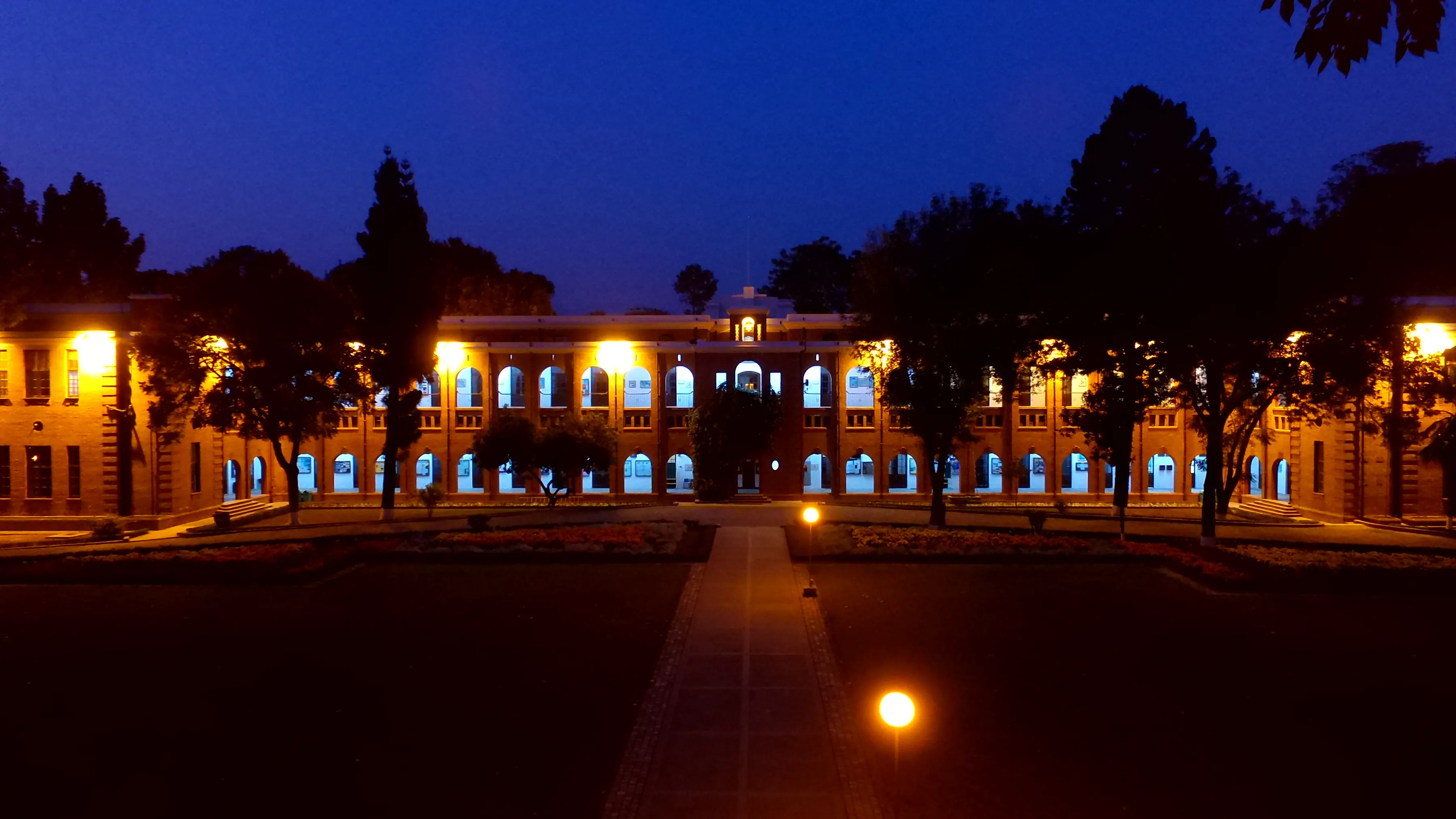
Originally the Forest Research Institute's building, over a hundred years old; now offices and classrooms. Its restoration won an Honourable Mention in the 2016 UNESCO Asia-Pacific Awards for Cultural Heritage Conservation. It appeared on an India Post stamp in 2010 for the School's 75th year.
Open-air amphitheatre built mostly by boys and masters over two years in the 1930s. First play: The Merchant of Venice, directed by Jack Gibson, cast in Indian dress. Seats about two thousand; the Founder's Day speeches are held here.
A main playing field; once a separate estate bought from the descendants of Colonel James Skinner.
More than 150 species of trees, many planted by the foresters; about 170 bird species recorded. Salim Ali visited often in the 1940s–50s and introduced many boys to birdwatching.
These are heritage descriptions, not map directions. Use the Map for Founder’s venues.
Privilege brings responsibility, not entitlement. Every boy does social service each term; senior boys look after juniors; boys organise their own expeditions, publications and productions.
The motto, shown as a lamp held high on the crest, on blazers, colours and publications.
Foot's 1946 essay: the habit of choosing good over evil, clear thinking and expression, and a healthy body. By fourteen a boy should speak naturally to anyone; by seventeen, show sound judgement.
Non-denominational since its first term. The song book holds Urdu poetry, bhajans, hymns and verse in many Indian languages.
Entry by examination and interview with no reserved places; scholarships and bursaries. The School Council of elected masters and boys decides school policy; the School Captain is chosen each year by secret ballot.
The School began in 1935 with two houses, Martyn and Barritt. Houses were first named after their housemasters (Martyn, Barritt, Thomas, Gibson) and later renamed Hyderabad, Tata, Jaipur and Kashmir. Oberoi was added in 1991. From the 1970s the houses were split into A and B halves and reunited around 2003–2008.
House colours appear as accents. The colours are sampled from the exhibition canvases, so they are close but not yet confirmed as official.
Holding house
A Foundation for the Journey Ahead
The Holding House system began in 1940 to give younger boys a sheltered introduction to Doon. On campus, Foot House took boys bound for Jaipur and Kashmir.
Discontinued in 1972, revived in 1980; after 1991 it also welcomed Oberoi's youngest boys.
Foot is more than a Holding House; it is the beginning of a Dosco's journey.
The House of Nizams
Founded 1935 as Martyn House. Named after Sir Akbar Hydari, who secured a donation from the Nizam of Hyderabad's government. First housemaster: J.A.K. Martyn.
The first house of the School. Under Martyn came the eleven-year housemaster tenure, social service, midterms and hill trekking, the Rose Bowl, the trees of the Main Field, Panchayat Ghar and Tunwala.
Mr Muinuddin (1946–50) was remembered for his cheer 'Hip Foot Foot Foot'. The HA/HB era began a Holika-Daan tradition of song and festivities the night before Holi.
From the house history: Politicians from India and Pakistan, a long-serving central minister, industrialists, bureaucrats, writers, sportsmen (golf, cricket, polo, squash, tennis) and a Headmaster of the School.
The enduring spirit of Hyderabad lies in its combination of tradition, achievement and a strong sense of community.
The House of Eagles
Founded 1936 as Thomas House. Named after The Jaipur Durbar, which contributed funds. Emblem: the eagle. First housemaster: C.L. Howell-Thomas.
Moved into its own building in 1937 with 49 boys. Thomas started the first cross-country race in 1939.
The postponed 1939 Founder's Day was held in Jaipur's courtyard in March 1940. Nehru and Mrs Gandhi had supper here in May 1947. Gurdial Singh, of Trisul and Everest, became its housemaster. Housemasters 'Kaddu' and 'Bond' (Kandhari and Vohra) ran JA and JB as one house. A lone camphor tree has served generations as an impromptu cricket pitch.
From the house history: An internationally acclaimed writer, two Magsaysay award winners, four Chairmen of the Board of Governors, the first Rhodes Scholar, and the only boy to captain the School in all three major sports in one year. Seven former housemasters became Deputy Headmaster. The house began the Marker Cups.
The eagle symbolises Jaipur's ambition, resilience and determination to keep reaching higher.
The House of Gentlemen
Founded 1937 as Gibson House. Named after Maharaja Hari Singh of Kashmir, who donated funds. Emblem: the chinar leaf. First housemaster: J.T.M. Gibson.
Started with 'Pilgrim Fathers' moved from the other three houses. Gibson, a passionate mountaineer, led a lantern-lit 3 a.m. climb of Bhadraj; a Kashmir party later made the first climb of Nag Tibba.
In 1938 Martyn and Gibson staged a comic stand-off over a civet cat. Rajiv and Sanjay Gandhi were in the house under K.C. Joshi, who 'seemed to know everyone's grandfather'.
From the house history: A Prime Minister, ministers, the longest-serving Chief Minister, MPs, pioneers of the hotel and fast-food industries, and national and international sportsmen.
Kashmir's identity as the House of Gentlemen rests on character, camaraderie and a tradition of excellence.
Holding house
A Home for New Beginnings
Formerly Chestnuts House.
A holding house, formerly Chestnuts House. Its name recalls Mr J. A. K. Martyn, the pioneering Housemaster of the School's first House (which began as Martyn House and became Hyderabad).
Its line of Housemasters began with Mr Omendra Singh in 1981.
Martyn provides the foundation on which a lifetime of memories at Chandbagh is built.
The House of Honour
Founded 19 October 1991. Named after The Oberoi family. Emblem: the swan. First housemaster: M.C. Joshi (Oberoi A) and S.D. Bhatia (Oberoi B).
The newest house, established in 1991 despite early opposition over inter-house games. Boys were offered the choice to move in.
It was split into OA and OB until 2007 and became one house in 2008, when Ms Nargish Khambatta became its first Housemistress.
From the house history: Actors, hoteliers and business leaders.
The swan, Oberoi's emblem, represents the House's aspiration to progress with dignity, ambition and honour.
“True as Steel”
Founded 1935 as Barritt House. Named after The Tata Trusts. First housemaster: H.E. Barritt.
Barritt's boys first lived in rooms now part of Kashmir House, then moved in 1936 into the new Tata building, sleeping in Main Building classrooms while it was finished. R.L. Holdsworth, of Kamet fame, was housemaster for eleven years from 1940.
True to its motto, Tata's legacy is one of resilience, integrity and achievement.
Awarded to the house that wins the inter-house Cricket, Hockey and Football cups in the same year. The trophy was presented by Tata House Old Boys in 1986.
R.L. Holdsworth, later a Doon master, was on the first ascent of Kamet, remembered for smoking his pipe on the summit.
Gibson and Martyn, with a young Tenzing Norgay, reached the summit ridge of Bandarpunch. Tenzing later called it 'the Doon School mountain'.
Holdsworth and Martyn took three boys, including Nandu Jayal, into the Arwa valley, climbing to about 6,000 metres.
Geography master Gurdial Singh led independent India's first mountaineering expedition, to Trisul (7,120 m), and did a headstand on the summit, widely seen as the beginning of Indian mountaineering. The same year two Doon boys climbed the Matterhorn in cricket boots.
Old Boy Nandu Jayal became the first Principal of the Himalayan Mountaineering Institute, Darjeeling; he summited Kamet in 1955.
Gurdial Singh was a member of India's first successful Everest expedition (Arjuna Award, Padma Shri).
A Doon team travelled to Antarctica, recorded by the School as the first Antarctic expedition by an Indian school.
Midterm destinations range from Himalayan treks and Everest Base Camp to the Thar Desert and cycling from Manali to Leh.
These are traditions, NOT the Founder’s 91 programme. Times, venues and whether each happens this year come only from the published programme. Open the programme.
Founder's Day marks the opening of the School in October 1935 and honours S.R. Das. It is the most important occasion of the School year, held over three or four days in the autumn term, bringing together parents, Old Boys, the Board of Governors and guests. Founder’s 91 follows the ninetieth-anniversary Founder's Day (DS90) in October 2025.
Sixteen words you’ll hear at Founder’s. Tap any word to ask Founder’s more.
The School estate, often used to mean the School itself.
A light early breakfast before morning exercise.
The matron of a house.
A Doon School boy, past or present.
The Doon School Old Boys' Society.
The general store on campus.
The Founder's Day Twenty20 cricket match between the School and the Old Boys, named after the master R.L. Holdsworth.
The School hospital.
The expedition week in the middle of each term.
The Founder's Day fete, run by a different house each year.
The open-air amphitheatre.
Lessons or class periods.
Socially Useful Productive Work, the compulsory social service programme.
Evening study time; from Winchester College, where Foot studied.
End-of-term examinations.
The Doon School Weekly, the boys' newspaper, published every Saturday since 1936.
III · Legacy
Chandbagh becomes the first home of the Imperial Forest Research Institute.
S.R. Das dies before the School opens.
First boys arrive (10 Sept); Lord Willingdon opens the School (27 Oct); Martyn and Barritt houses begin.
The Doon School Weekly first published; Thomas (Jaipur) House begins.
Gibson (Kashmir) House; Bandarpunch summit ridge with Tenzing Norgay.
The first leavers.
Foot writes 'The Objects of Education'.
Gurdial Singh leads independent India's first mountaineering expedition, to Trisul.
First Grand Slam, Hyderabad House.
Eric Simeon becomes the first Indian Headmaster.
Gulab Ramchandani becomes the first Old Boy Headmaster.
Golden Jubilee, presided over by Prime Minister Rajiv Gandhi, an Old Boy of Kashmir House.
Grand Slam trophy presented by Tata House Old Boys.
Oberoi House founded on 19 October.
India Post stamp marks the 75th year.
Doon team travels to Antarctica.
UNESCO Asia-Pacific Honourable Mention for the Main Building restoration.
Dr Jagpreet Singh becomes the eleventh Headmaster.
DS90, the ninetieth Founder's Day; Jaipur win the Grand Slam.
Jaipur win the Grand Slam again; Founder’s 91, 22–24 October.